Wednesday, August 22, 2012

Final Options


War & Cinema: Final Presentation Options


Choose an option below and construct a 10-12 minute presentation, including visuals (either powerpoint with stills or clips from a film you are analyzing).  The response to each option should be at least three paragraphs and posted to the blog – the template is helpful to use when appropriate.

First claim, first serve. You can reserve your show/film/game of choice at the end of class week 7 or email me as soon as you decide. I will be posting taken shows on the blog (on this post under the option), so please check this post before you email me. Certain options have unlimited possibilities – this is to ensure that no one presents the same media twice


You must use three sources, limited to scholarly articles, newspapers or magazine (no on-line reviews or forum quotes). Most option include at least one mandatory source—it is your responsibility to research and find the remaining sources. As always, cite all sources.

Make sure your presentation and clearly presenting an argument or analysis.

Option A:

Television & Violence: Episodic Battle

Read: Television violence and behavior: A research summary and use it to contextualize an episodic television show that revolves around war or battle.
You are free to choose the show but note that no show can be presented twice.

Use the following quote as a jumping point:

 Research...has revealed that violence on television plays an important role in communicating the social order and in leading to perceptions of the world as a mean and dangerous place. Symbolic victimization on television and real world fear among women and minorities, even if contrary to the facts, are highly relate

Please find and deconstruct the social order and symbolic victimization in the series and include a clip or visual to support your argument.

Some suggestions: Band of Brothers, Birdsong, Generation Kill, Game of Thrones, Battlestar Galactia.

Ben H - M*A*S*H
Jake - The Wire

 Option B:

The War Reporter

Read: The depiction of war reporters in Hollywood feature
films from the Vietnam war to the present and use it to frame a film that features a war reporter.

Present a singular film, with a developed war reporter as a character and present them  in relation to the time period the film was made. The essay chronicles a history of this archetype, it is important that the function of the character is presented in its historical context.

Some ideas worth presenting – authenticity, gender issues, journalistic ethics

Some suggestions: The Bedford Incident (1965), We Were Soldiers (2002), The Green Berets ( 1968), The Year of Living Dangerously (1982), Under Fire (1983), Three Kings (1999), War Photographer (2001) – documentary

Bradley Davis - War Photographer

Option C:

Propaganda and Horror Films of the 40’s

Read: OWI Meets the Monsters: Hollywood Horror Films and War Propaganda, 1942 to 1945, and use it to frame a horror film from the 1940’s.

Describe the relationship between OWI and Hollywood, specifically related to the film at hand if possible, and present the most obvious metaphors and symbols deployed.

Keep in mind the distinction between good and evil and the possibility of cold war or anti-communist sentiment. Draw distinction between horror and pathos.

Suggestions: Dead of Night (1945), The Body Snatcher (1945), The Devil Commands, The (1941), The Ghost Breakers (1940), Man Made Monster (1941), Beast with Five Fingers, The (1946), Bedlam (1946), I Walked with a Zombie (1943), The Lady and the Monster (1944), The Picture of Dorian Gray (1945), The Wolf Man (1941)


Option D:

War & Comedy

Choose a particular comedic film and present its simplification of violence or use of satire to reveal truths. Consider the article, The best humour is satire, and there's a reason we have so little of it today

You are required to use professional reviews or articles about your specific film as your remaining sources.

Suggestions: Stripes, The Great Dictator, Hot Shot! Part Deux, Catch-22, Kelly's Heroes, To Be Or Not To Be, Starship Troopers, Bananas

Kerry Kutzer - Catch 22
Christiane Butler - Starship Troopers
Carol Ostling
Aaron Charney - Bananas
Kevin Fisk - Hot Shots

Option E:

Video Games and the Military

Read, Video games gaining clout as military training tools & Adapting video games for military application and present a particular game that promotes engagement with war.

There are two additional sources Video games sub reading 1 & 2 posted on ecompanion that you should read as well.

Create a powerpoint with stills and argue in support or against the use of these games in the military.

The game must contain actual battle or a game cleared for training purposes.

Mike Mitchell - Mass Effect

Option F:

War Comic Books in America

Read, The Dream of Total War and choose a particular war comic and present the clear distinction of good and evil within a historical and social context.

Bryan Tosh - Sgt. Rock

Option G


The Auteur & War Cinema

With Auteur Theory as a base, describe how one of the following directors imprinted their markedly stylistic tendencies in a war film.

Read, The Auteur Theory of Film: Holy or Just Full of Holes? And make a case in support of or suspicion of auteur theory.


Must choose from one of the following directors:

Yi Man­hui (article provided) - Taken by Jin
Errol Morris - Taken by Mark
Steven Soderbergh
Akira Kurosawa
David Lean - Taken by Andrew

Option H

Feminism & War 


Read, Feminist folkloristics and women's cinema: Towards a methodology.

“Koven argues that the deciding factor of gendered cinema is not to be found in the biological sex of the director or screenwriter, and that the only way a feminine voice can be heard is by a radical shift in the narrative codes.”

Use this idea as a jumping point to analyze Courage Under Fire, A Few Good Men or G.I Jane.

Homework Week Seven

Any contemporary war film (made in the last 20 years)
Some Suggestions:
The Hurt Locker - Kathryn Bigelow
Three Kings – David O Russell
Empire of the Sun – Steven Spielberg
Inglorious Bastards – Quentin Tarantino
Ride with the Devil  - Ang Lee
The Sun – Aleksandr Sokurov
Black Book – Paul Verhoeven
Courage Under Fire -- Edward Swick

This is your last analysis before your Final Project. Be sure to be thorough and check for spelling/grammar. Complete and template and point out examples of the following: P.O.V., Identity, Morality & Memory. Please separate by heading-- ex. 
P.O.V
blah blah
IDENTITY
blah blah blah

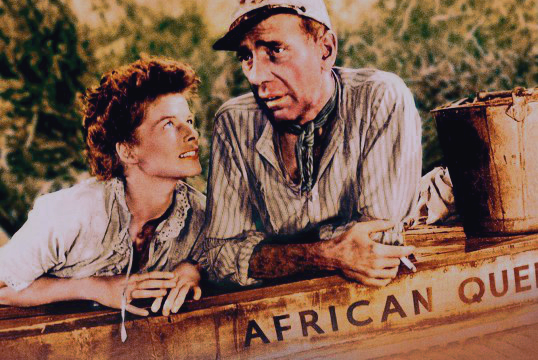
African Queen by Zachary vanBuuren


Title/Year; African Queen/1951

Director/Birth Country/Year Born; John Huston/U.S./1906

Budget; 1.3 million

Gross; 4.3 million

Synopsis; Humphrey Bogart plays Charlie Allnut, captain of a small cargo ship named the African Queen that delivers mail and supplies to villages and christian missionaries along the river in then unoccupied but German controlled east Africa in 1914 during the onset of WW1. Allnut informers Miss Rose Sayer, played by Katharine Hepburn that the Germans are eradicating the populace. On a return trip a few days later, Allut finds the village destroyed and Miss Sayer burying her dead brother. They set down the river back to civilization together and Miss Sayer is rather perturbed by the drunken, filthy lifestyle lived by riverboat captain Allnut. Allnut attempts to become a gentleman and eventually Miss Sayer is charmed by Bogart’s performance. She convinces him to turn his small steamboat into a warship by constructing rudimentary torpedoes and mounting them of the bow of the Queen so they can attempt to engage a large German warship in battle that protects the lake. Allnut begrudgingly agrees and they make their way past crocodile and leech infested waters, treacherous rapids, and a near call with a German military outpost while developing romantic reliance upon each other. At the mouth of the river, the boat gets lost in the delta and the couple nearly dies from fever and dehydration. A flash rainstorm creates a swell of water and it pushes them into the large lake. The Queen is rolled over on the attack run, Sayer and Allnut are picked up by the Germans. During the questioning the German gunship accidentally runs into the wrecked African Queen, the torpedoes blow a hole in the ship, And the river weary couple rejoice having done their godly duty.

Narrative and Visual Keywords; Charming, Proper, Christian, Rugged.

Characterization/ Dialogue; Bogart plays a drunk Englishman, while Hepburn plays a very (christian) proper lady of the time. The dialogue is very simple, but effective.

Camera/lighting/editing technique; Technicolor. Flat visuals. Digestible.

Political/ Social Commentary; Portrayal of Germans as warrish brutes.


Historical Relevance/ Recognition; The ships and technology were researched and portrayed correctly.  

Notable Collaboration; Bogart and Huston.


Random fact, Etc; The script had to be re-written for Bogart as he was incapable of producing a cockney accent well enough.


1. Did you find any evidence of ineffective military leadership (associated with upper-class ineptitude) that is compensated for through hard work and commitment of the lowly infantryman? Any scene where difference in social class is evident? Describe the dynamic or scene in which this theme is portrayed.
~In the final scene where Bogart and Hepburn are captured by the Germans, the commander is loud and garish. There is a lack of military respect present on the German gunship.
2. Does the film show a suffering soldier as a victim of war rather than exposing the structure of violence and presenting soldiers as elements in it? Or does it portray the soldier as a strong individual following codes of honor and duty How does the film achieve this point of view?
~The film only has passing shots of soldiers running around doing the commands barked at them by their superiors. They are just peons at the whim of the officers. 
3. Does the film offer the audience the familiar pleasures of cinema – the romantic scenarios and melodramatic poses woven into a more direct and immediate sense of war? What elements of spectacle in the story (battle scenes or otherwise) achieve a sense of melodrama? 
~This film is primarily a romantic Hollywood story featuring a man and woman falling in love while battling adversities. They are dealing with elements of the war being an antagonistic force, but it is an equal battle to fight their way through the wilderness. The climactic ending of the film sends the message that love conquers all, war be dammed.
4. Is the enemy portrayed as neutral or through hysterical exaggerations of atrocity? 
~The Germans are just "the enemy" but it is never elaborated why. this makes them very neutral. 

Thin Red Line by Zachary vanBuuren


Title/Year; The Thin Red Line /1998

Director/Birth Country/Year Born; Terrence Malick/U.S./1943

Budget; 52 million

Gross; 98.12 million

Synopsis; The Thin Red Line follows the battle of the infantry line during the WWII battle of Mount Austen. The film follows the soldiers through personal flashback stories giving the characters a greater amount of depth and allowing great perspective into the psyche of the individuals. Many of the characters back stories are given with good detail, giving reason to their reaction in battle. The story is driven in battle by the demanding push of Nick Nolte playing LT. Colonel Tall demanding the squadron to advance on a heavily fortified Japanese bunker. Elias Koteas playing Captain Staros defies his commanding officers orders, not wanting to lose any lives of his men. To show a very human side of the story, Jim Caviezel as Private Witt plays a soldier who is retrieved from a tropical island after going a.w.o.l. who has found an inner peace. The film has many scenes dictated with Witt's internal dialogue as a mental response to what is happening in the battles around him. Wit begrudgingly re-enters the military and becomes the lens through which we spectate the insanity of war and the effects that it has on soldiers.

Keywords; Poetic. Moving. Insightful. Philosophical. 

Characterization/ Dialogue; The characters are portrayed with rather
realistic dialogue. The script is very digestible and the performance  is easy to believe.

Camera/lighting/editing technique; The Thin Red Line is shot in such a way that it coveys a gritty realism of the characters.  Long shots holding on the expressions, actions and reactions of the soldiers are meant to allow the viewer to ponder the weight of the situations presented.

Political/ Social Commentary; The film is quite clear about the message of the absurdity and insanity of war. The focus on the a LT. Colonel Tall grasping for power in a last chance for fame is displayed in a rather feasible manner.

Historical Relevance/ Recognition;
The Thin Red Line was director Terrence Malick's return to directing after a twenty year hiatus.

Notable Collaboration;
Mickey Rourke, Bill Pullman, Lukas Haas, Gary Oldman, Billy Bob Thornton, Martin Sheen, Jason Patric and Viggo Mortenson all were in the original cast. When it came to the final edit of almost 3 hours, all of their parts had been removed. 

Random fact;
There is a continuing rumor of a 'legendary' 5 hour cut of the film. Malick has claimed that it is simply the assembly edit and he has only ever had the patience to sit through it once. 

*Pick out bits of dialogue, visual images, or scenes which you consider especially effective in revealing character and tell why they are effective.
 ~There are many striking shots peppered throughout the film. They are present to show moments of internal peace and contemplation for Private Witt. These shots are well composed, well paced and exude a sense of calmness and momentary removal from the context from which they are displayed. They effectively remove the viewer from the mindset of battle and place clear emphasis on the voice over of internal monologue that is usually concurrent with the break-away visuals.
  *Which characters function as stock characters and stereotypes and how can the presence of each be justified in the film?
~ Oddly, the character of Corporal Fife played by Adrien Brody  was one of the largest differences from how the story plays out from the original novel. The book follows Cpl. Fife thoroughly and the story is through his eyes. From the reduction of the film in the editing process, Brody's performance was whittled down to just a supporting character with about 5 minutes of screen time. This is partially because he plays a typical soldier and through the eyes of the director, he became a stock character.

 http://blogs.indiewire.com/theplaylist/16_things_you_need_to_know_about_terrence_malicks_the_thin_red_line
 http://www.rottentomatoes.com/m/1084146-thin_red_line/
 http://www.imdb.com/title/tt0120863/


Sunday, August 19, 2012

The Hanoi Hilton (1987) by Andrew Barrick


The Hanoi Hilton / 1987

Directed By: Lionel Chetwynd / England / 1940

Budget: Unknown (Independent)

Gross: Approx. $760,000

Synopsis: Prisoner of war drama set during the Vietnam War era. The film follows a number of American POWs over a course of years during their imprisonment at Hoa Lo prison. The story is told from the captives perspective as they battle physical and mental torture at the "Hanoi Hilton".

Keywords: Vietnam War, Prisoner of War, Torture, Prison, Emotional Suffering, Escape, Freedom.

Characterization/Dialogue: The Hanoi Hilton introduces full characters who learn more about themselves and their fellow POWs as the suffer through their hardships while being locked up at the "Hanoi Hilton" The war prisoners communicate with each other during the film through secret notes, Morse Code, and physical contact with each other.

Camera/Lighting/Editing Technique: Filmed in a standard drama format. Shot-Reverse-Shot. Modest pace of editing to help convey the emotional drama of the film.

Political/Social Commentary: The film sets out to show a realistic recreation of the atrocities that occurred at the "Hanoi Hilton". The Vietnamese prison warden attempts to break the American POWs will, and get them to apologize for their wrong doings, in efforts to gain a political upper hand on the American government.

Notable Collaboration: The film production was assisted by former POWs who spent time at Hoa Lo prison including presidential nominee Sen. John McCain.

Random Fact: During it's limited release the film received mild response, today however the film has become a cult favorite among war veterans.

Sources: http://www.imdb.com/title/tt0093143/
               http://boxofficemojo.com/movies/?id=hanoihilton.htm
               http://en.wikipedia.org/wiki/The_Hanoi_Hilton_(film)
               http://en.wikipedia.org/wiki/Hanoi_Hilton

1. Is the soldier/veteran depicted as being in control of his destiny?
No. Throughout the majority of the film the soldiers, who are actually prisoners of war, are never given the chance to fully be in control of their destinies. The Americans are never in control of what will happen to them next. They never know if they will get food or not, or if they are about to be taken from their prison cells and savagely beaten. At one point in the film two prisoners are able to make an escape attempt but their efforts are quickly thwarted by the Vietnamese troops.


2. What political sub-text, or overt theme is the film exploring?I would say that the over all sub-text of the film "The Hanoi Hilton", would be that it is important to remember what the American soldiers fought and suffered for. Aside from the American and Vietnamese political agendas, it again, is essential that we honor those who serve our nation.

3. How are masculinity and patriarchy displayed through the main character(s) -- broken and dissociated or reinstated and productive.
I would say that the film plays to both dissociated and productive principles. We are shown masculine soldiers who are often turned to tears as they are "broken" by their captors. Yet the POWs keep as a whole unit of reinstated men who band together in hopes of saving each other and regaining their freedom. These soilders truly care for each other and will do what they can to encourage and support their commrades. If a prisoner is physicaly or emotionally wounded another will come in to comfort thier pain and suffering. They are all one unit, banded together.

Wednesday, August 15, 2012

Pretty Village Pretty Flame-Carol and mike


Pretty Village, Pretty Flame is a Serbian film based on actual events set during the Bosnian War. It focuses primarily on the relationship between Milan and Halil, two friends that become divided by war.                

All of the character's backstory is told through flashback so there is quite a bit of jumping around in time, which means lots of jump cuts. It feels pretty chaotic at first because of all the ground it needs to cover but after our main characters get stuck in the cave and the story gets a bit more focused, the timing is really great. For example, when someone gets shot and at the moment they touch the ground we cut to a similar moment, which tells the viewer we are in a flashback now without having to use a weird filter or constantly having text on the screen that denotes the year. And once we get to know them better it becomes even more apparent when we are. It isn't always clear exactly why the director and editor chose the shots they did but often the juxtiposition of one event in that characters life to another can be very telling.

                The overall sound design was pretty good; fired guns, shattering glass, exploding grenades and on down to the more subtle things like the click of Lisa's camera and the sloshing of liquid in the coke bottle were as crisp and present as you would expect. I just had one problem with it though. Sounds of physical contact and stuff like the thumb being cut by the scissors sounded really cartoony and out of place, exaggerated slaps and yells that pulled me out of the film's gritty tone and made me feel like I was watching an incredibly grim three stooges skit for just a moment.

I’m not always a fan of anti-war films something about them has often rubbed me the wrong way. Some movies I don’t mind, like Apocalypse Now or Good Morning Vietnam. Pretty Village Pretty Flame, however, did not restore my faith in the anti-war category. 

The director was trying to show us that war is hell. I think that was even a quote in the movie (way to be subtle). There was plenty of blood, guns, and fire to go around and lots of symbolism. So much so I often found my self disoriented in a labyrinth of symbols. Even after watching it a second time I felt just as mystified.  There were very few, very brief and fleeting moments that I think I understood what the director was trying to convince me.

One of the many elements and symbols that the director tries to illustrate is the psychology of war. There is a scene in the movie when the men of the unit start drinking Milan’s pee because they are getting dehydrated. This is probably my favorite scene in the movie because good instance of how they must do things that are distasteful in order to survive. This is also their greatest moment of unity in the group were they all have to drink one man’s pee. I understood that scene, I felt it, and there was a universal language there. It was the expression of “this is such an extreme event and all I can do is laugh”.

Then he kills it again. The way the director told the story made little to no sense. In the movie we see young Milan, Milan in hospital, Milan before the war, Milan during the war and so on. Every time I felt like I was starting to connect with a character or understand the movie further I was literally drawn way to another scene. Maybe the biggest problem for me is that this was a symbolism movie is for a people in another land, speaking another language of which I have no connection to expect a page from a history book. I was like stranger in a strange land.           


Dr. Stranglove or: how i learned to stop worrying and love the bomb By Kevin Fisk, Zachary Van Buuren, Sung Jin In


In a day when everyone was living in constant paranoia, and nerves were being tested by the possibility of nuclear war, I admire how Stanley Kubrick’s Dr. Strangelove took a lighthearted stab at what seemed like such a serious issue at the time.  Kubrick uses comedy, suspense and a lot of symbolism to help contribute to the overall theme of the film.  During the opening credits, the audience is treated to a B-2 bomber being refueled mid flight to a fifties lovemaking instrumental.  This, bookended with a bevy of nuclear explosions at the end, is a telling sign.  More symbolism of this sexual nature exists throughout the film in the form of cigars, machine guns, and even a cowboy fighter pilot who rides an atomic bomb between his legs all the way to the ground. Kubrick uses these symbols to show the ridiculous nature of war room politics as well as spotlight the masculine overtones of battle.  Kubrick decided that humor was the most effective way to portray his view of the existential fatalistic view of the nuclear threat of the 1950's. 
The plot originally came from the book Red Alert written by Peter George.  Kubric loved the book, but also thought documentary or drama on a threatening subject like nuclear war could have a negative effect on viewers. 
Dr. Strangelove is full of colorful, hard headed but passionate and outrageous characters. The names chosen for these characters, were an obvious attempt at the aforementioned symbolism, and also added to the films comedic effect.  During the first scene we are introduced to two characters who could be described as polar opposites.  Ultra-masculine Airforce General Jack Ripper tells Captain Mandrake, a stuttering flight commander with a broken leg, his decision to destroy Russia with multiple simultaneous nuclear attacks. Throughout the film, Mandrake ignores multiple opportunities to dissuade the maniac Ripper.  He just isn’t masculine enough. In the next scene, there is American President Merklin Muffley.  Muffley is a small, bald man who can’t seem to commit to anything, even when he is told his planes will be attacking sites within Russia in under 25 minutes.  Muffley argues with one of his subordinates, General Buck Turdgeson over how to handle the situation. Muffley then has a hilarious exchange over the phone with the Russian president, where they argued with one another about who was the most sorry out of the two.  The amazing thing is Captain Mandrake, President Muffley and Dr. Strangelove were played by the same actor, Peter Sellers.
The film wasn’t an exact depiction of the government and military, however it probably was a conscious choice by Kubrick to show the contrast between ordinary humans and the qualities of humans who rely on machines and technology to serve the purposes they were programmed for.  The way Kubric portrays the use of technology sticks out in this film with constant scenes that focus on large mechanisms that surrounded these central figures.  Whether it was in the war room or cockpit of the air force plane. Ironically, all communicative devices always failed to serve their purpose except to lead mankind to doomsday. I.E., when the R.A.F officer tried to contact President Mufflin though a public payphone, the destroyed radio on the plane that made it impossible to recall the order. Even if the use of these communicative devices were successful, it often had ridiculous conversation that just strayed the characters from their original purposes (like the conversation between the US President and the Russian Premier). Ultimately technologies can only carry on what they were programmed to, but how they are used, are up to those who are capable of logical thoughts, such as human beings.
The film also does a good job blending genres.  During the war room scene, the war table resembled a massive poker table with the country’s top officials partaking in the action.  The camera shots were slow and methodical, milking the suspense out of every shot.  It was as if Kubrick wanted this scene to seem like a poker match was taking place with the fate of the world in balance.  The theme of impotent leaders of society leading to the earths destruction was so in your face, that I think the level of ambition is quite high.  The entire film was not shot the same way either.  The ground battle scenes had more of a documentary feel, and when the plane was dodging a Russian missile, the cuts were quick. 
Peter Sellers performance as multiple characters in the film adds greatly to the humor element, but detracts from the plausibility of the message of the film. While the message could have been delivered more accurately with a full ensemble cast, it would detract from the greatness of the film as it is. Sellers performance is a quality and charm by itself that is an element that makes the film historically great. 
I enjoyed the film greatly, especially in regards to the time it was made and what was considered to do that was "acceptable" as contemporary cinema. Kubrick's characters and imagery have seeded many homages since the time of the films release. It is a prime example of it's genre.